The Alpine Network of Protected Areas


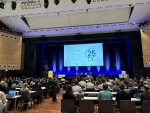
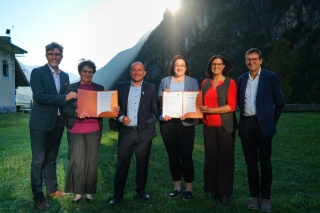
Last week, ALPARC joined the celebrations for the 25th anniversary of the Interreg Alpine Space Programme in Salzburg!
The event was a great opportunity to share experiences, connect with the many actors involved in the protection and sustainable development of the Alpine region, and build new synergies for future transnational cooperation.
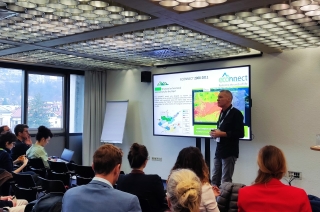
We also had the chance to showcase our ongoing projects, AlpsLife and LiveAlpsNature, together with our partners Eurac - Institute for Alpine Environment and CIPRA.
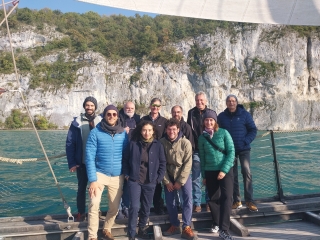
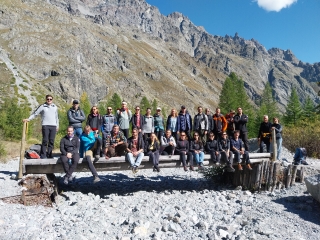
On the closing day, the colleagues from Nationalpark Berchtesgaden led a field trip at the foot of the Watzmann, organised in collaboration with the Joint Secretariat of the Interreg Alpine Space Programme and ALPARC. Blessed with a beautiful sunny sky, the excursion highlighted practical actions of the park linked to the key topics of both projects:
A valuable example of how Interreg projects can make a tangible contribution to the conservation of Alpine natural heritage!
© cover photo: Mathilde Maure / Eurac

The AlpsLife project (Interreg Alpine Space) is currently collecting key data through a questionnaire aimed at Alpine protected areas. We warmly invite all protected areas across the Alpine region to participate and contribute to this important step of the project. The questionnaire is designed to gather information on:
· What is being monitored in your protected area (species, habitats, indicators, etc.)
· How monitoring is conducted, including methodologies, frequency, and tools
· Management measures linked to biodiversity monitoring results
This initiative forms the basis of Work Package 3, coordinated by ALPARC, and plays a central role in assessing current monitoring schemes across the Alps. By participating, your protected area can actively support the development of shared standards and approaches that enhance data comparability at the Alpine scale.
Even beyond the scope of the AlpsLife project, this initiative represents a step toward greater harmonization of biodiversity data, making it easier to compare trends, respond to threats, and design effective conservation strategies at the regional level.
Take part in shaping this process!
If your protected area has not yet filled in the questionnaire, now is the time to get involved. Completing it is a concrete way to make your monitoring efforts visible and contribute to a stronger, more connected network of Alpine protected areas.
Download the Excel file below, containing the questionnaire: inside you’ll find all the instructions.
Thank you for your valuable contribution to AlpsLife. Together we can build a more resilient and connected Alpine biodiversity monitoring system.
For more information about the project: https://www.alpine-space.eu/project/alpslife/
The AlpsLife project is co-funded by the European Union through the Interreg Alpine Space programme, which supports cross-border cooperation projects between seven Alpine countries.
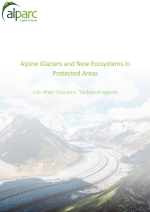
Life After Glaciers - Technical report
As one of the most visible signs of climate change, glacier retreat is reshaping Alpine landscapes at an alarming rate. The Alps, one of the most vulnerable regions, are experiencing rapid ecological changes that affect both nature and people.
In response, ALPARC has undertaken a study to explore the ecological consequences of glacier loss in Alpine protected areas - with a focus on landscape transformation, species colonization and adaptation. The aim: to understand key dynamics in post-glacial ecosystems and develop conservation and communication strategies that support emerging biodiversity.
Discover the results and download the final report.
For mor information about the project: Life After Glaciers
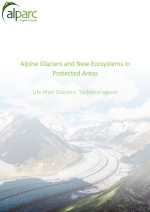
ALPARC has published a new report titled “Alpine Glaciers and New Ecosystems in Alpine Protected Areas”, which is now available to read or download here:
https://alparc.org/alpine-resources/alpine-glaciers-and-new-ecosystems-in-protected-reas
The report explores the ecological impacts of glacier retreat across Alpine protected areas, with a focus on landscape transformation, species colonization, and adaptive processes. Its aim is to identify key interactions within post-glacial ecosystems and to propose both conservation and communication strategies to support the emergence of new forms of biodiversity.
Key achievements of the report include:
The report was developed with the collaboration of 15 stakeholders, including 14 Alpine protected areas, who contributed through survey responses, data sharing, email exchanges, and participation in a dedicated workshop.
The project behind the report
This report is part of the Life After Glacier project, developed as a contribution to the International Year 2025 for the Conservation of Glaciers. The project carried out a first assessment of glacier retreat and its ecological consequences in Alpine protected areas, with a view to identifying appropriate management and conservation responses. Special attention was given to emerging ecosystems and the evolution of life in post-glacial environments—areas of high ecological and symbolic value for Alpine heritage. The project was co-funded by the French national fund for regional planning and development (CIMA / FNADT 2024).
To learn more about the project, visit https://alparc.org/life-after-glaciers-2
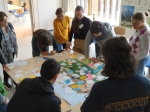
As Alpine tourism becomes increasingly a mass phenomenon, protected areas can serve as model actors for sustainable regional development. At the same time, their mission remains first and foremost the conservation of Alpine biodiversity, meaning tourist offers in these areas must be geared accordingly.
These were the starting hypotheses of the WELCOME project, carried out by ALPARC with the financial support of the German Ministry for the Environment, Climate Action, Nature Conservation and Nuclear Safety (BMUKN). On March 27th–28th, Nationalpark Berchtesgaden hosted the project’s final event, which brought together managers of Alpine protected areas and other stakeholders involved in promoting sustainable, biodiversity-compliant tourism.
During the meeting, participants showcased good practices implemented in their parks as regards, on the one hand, monitoring, assessment, and management of visitor impacts and, on the other hand, innovative offers and approaches aimed at reducing them. These topics were further explored in a dedicated workshop. Exchanges among experts highlighted both the challenges of introducing innovation in such sensitive environments, but also the great potential arising from the unique heritage of these territories and the collaboration with local stakeholders. Together, they also developed a scenario for the future of tourism in Alpine protected areas by 2040, envisaging an ideal situation and identifying both obstacles to overcome and opportunities to seize to achieve it.
The event concluded with a guided excursion through the Klausbach Valley. The staff of Nationalpark Berchtesgaden presented their actions in the area, including visitor flow management through a redesigned park entrance, visitor monitoring using counters and surveys, and new educational initiatives focused on the bearded vulture and the natural processes of carcass decomposition.
Many thanks to all participants for their contributions and to Nationalpark Berchtesgaden for supporting the organisation of the event!
Insights and outcomes from the event have been included in the WELCOME Project Final Report.
For more information about the project: WELCOME project
The full event program is available here: WELCOME Closing Event
The project is co-funded by the German Federal Ministry for the Environment, Nature Conservation, Nuclear Safety and Consumer Protection (BMUV).
© photo: Pietro Merzi / ALPARC
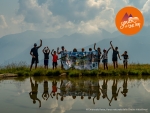
Registration for Youth at the Top 2025 is now open! Click here to register your local event – registration is possible until April 30, 2025.
The 11th edition of Youth at the Top will take place on July 17 and 18, 2025 (or adapted to local conditions within the week of July 14–20, 2025) across various protected areas in the Alps and Carpathians. Kids and teens are invited to participate in local events as part of this international initiative.
This event is a great opportunity to raise awareness about nature conservation and preservation among young people. The 2025 edition focuses on the common theme "Our Footprints in the Alps", encouraging participants to explore the different impacts humans have on the Alpine environment.
For more information about the event's organization, please refer to the project sheet.
© Emanuele Rotta, Parco naturale delle Orobie Valtellinesi
The closing event of the WELCOME project will take place on 27-28 March 2025 at the House of the Mountains in Berchtesgaden!
Overtourism and the boom in outdoor activities are increasingly relegating the Alps to a mere backdrop for sporting activities, threatening their unique natural and cultural heritage. WELCOME addresses these challenges by exploring innovative, sustainable and integrative tourism strategies that balance recreational use with nature conservation.
The event will present and discuss the results of the project's three core themes: an exchange about existing offers of protected areas and their future perspectives, a presentation of emerging trends and innovative concepts for new activities, and a reflexion about the limits of visitor growth in natural sensitive areas.
The closing event is free of charge and open to all that are interested. Travel and accomodation costs are covered individually by each participant. The final agenda can be downloaded below! Click here to register.
The project is co-funded by the German Federal Ministry for the Environment, Nature Conservation, Nuclear Safety and Consumer Protection (BMUV).

The next meeting of the ALPARC Permanent Working Group on Education will take place on 26 March 2025, 15:00-18:00.
It will be held in person at the Haus der Berge, in Berchtesgaden.
Participants will also have the opportunity to join the closing event of the WELCOME project, which addresses topics strictly related to environmental education.
We kindly ask you to register by Sunday 16 March 2025, by selecting the specific option in the registration form of the WELCOME Closing Event.
If you have any questions, please do not hesitate to contact us at info@alparc.org
We're pleased to announce that the registration deadline for the WELCOME closing event has been extended to Sunday 16 March : Register here.
The closing event of the WELCOME project will take place on 27-28 March 2025 at the House of the Mountains in Berchtesgaden!
The event will present and discuss the results of the project's three core themes: an exchange about existing visitor offers of protected areas and their future perspectives, a presentation of emerging trends in Alpine protected area tourism, as well as innovative concepts for new activities, and a reflexion about the limits of visitor growth in natural sensitive areas.
Participation is free of charge and open to all that are interested. Travel and accomodation costs are covered individually by each participant.
We Thank the National Park Berchtesgaden for hosting the event!
Click here to find out more about the event and to download the draft agenda.
The project is co-funded by the German Federal Ministry for the Environment, Nature Conservation, Nuclear Safety and Consumer Protection (BMUV).
Est. 2004 (The area has been part of Natura2000 since 2000)
Goals & Objectives:
To consolidate the nature park in the region as a competent organisation for nature conservation, and to involve the local community so that they may further identify with the nature park and its region.
Regional & Environmental Challenges:
A core element of the park is the wild river Lech and its tributaries, and riparian forests. Challenges arise with visitor management, as the land use and leisure activity pressures increase in sensitive areas, especially with regards to the river system disruption.
Successes:
Successful annual preservation efforts of flagship species and their habitatis, such as the highly endangered natterjack toad. 13 river engineering measures have been implemented for the redynamisation of the Lech, as part of the LIFE-Lech project; various comprehensive species' protection measures.
Learn more about Tiroler Lech Nature Park's initiatives and projects on their website.
What challenges do you see for protected areas in the coming years/decades?
The challenge will be to ensure that protected areas are not "islands" [fragmented nature spots], but also connect spatially, and work as a network for the conservation of biodiversity.
How important do you think protected areas will be in the coming years?
Protected areas are likely to become increasingly important, as they are areas that promise natural states, and preserve connectedness with nature.
What can we gain from stronger international cooperation with regards to Alpine conservation efforts, and climate change mitigatin and/or adaptation?
Only together, with targeted efforts, can the inclusion of global challenges such as climate change and biodiversity loss happen, and the understanding of the value of nature be strengthened.
Est. 1963
Goals & Objectives:
Vanoise National Park was created to protect the Alpine Ibex. Protection was subsequently extended to other animal and plant species, the current focus being the Bearded Vulture.
Statistical Profile:
400km of marked trails
40 refuges in the heart of the park
5 nature reserves adjacent to the National Park
224 protected species
Successes:
From around 60 ibexes at the Park's inception, there are now more than 2,000. The first breeding pair of Bearded Vultures were introduced in 1998 - there are currently 9 breeding pairs in Savoie, and this year 7 new young will have flown the nest: a new record!
Learn more about Vanoise National Park's initiatives and projects on their website.
How can we describe the Vanoise National Park?
The park is located in the east of the Savoie department, on the Vanoise massif, which links the two valleys of Maurienne and Tarentaise, close to the Italian border. Thanks to their shared 14 km border, together with Italian Gran Paradiso National Park, Vanoise National Park forms one of the largest protected areas in Western Europe, covering 1,250km². At its heart, 53,500ha are under special protection by specific regulations laid down by decree in the Council of State.
With 33 natural habitats (31 of which are of local community concern), more than 2,500 plant species (around a hundred of which are protected at national level), and 325 vertebrate species representing 65% of vertebrates found in mainland France (92% of which are protected species), the Vanoise National Park is a vast reservoir of biodiversity.
What do you gain from being an ALPARC member?
ALPARC is particularly useful for sharing experiences across borders and having an impact on a wider scale. For example, we have successfully collaborated with them for their public conscientisation intiiative: Be Part of the Mountain.
Est. 1914
Goals & Objectives:
The Swiss National Park is a strict nature reserve classified as IUCN Category 1a. Its duties include the complete protection of all living organisms and natural processes, scientific research, and public outreach.
Regional & Environmental Challenges:
A major challenge is the remediation of highly toxic PCB contamination in the Spöl River, caused by faulty repair work at a hydroelectric power plant.
Successes:
In the Swiss National Park, biodiversity is increasing in contrast to other areas: bearded vultures, lynxes, wolves, and otters are once again part of the region’s fauna. Today, the same number of butterfly species still live in the park as they did 100 years ago.
Learn more about Swiss National Park's initiatives and projects on their website.
What do you gain from being an ALPARC member?
The exchange with international partners is very valuable to us, and many acquaintances and friendships have developed over time. This creates a sense of unity, allowing us to benefit mutually from each other’s experiences.
What challenges do you see for protected areas in the coming years/decades?
At the moment, politics is not very supportive of nature conservation. We must be careful not to recklessly lose the achievements of the last 40 years. Nature and biodiversity are the foundation of our lives, but it is becoming increasingly challenging to designate protected areas due to individual interests.
How important do you think protected areas will be in the coming years?
They are becoming increasingly important as refuges for flora and fauna. However, the population is also growing, along with the number of people seeking experiences and tranquility in remote and natural areas. As a result, these valuable oases of nature are coming under greater pressure.